FLINTKWARTIER
Program:
Housing & Cultural program
Year:
2025
Clients:
Europan 18, Municipality of Amersfoort
Status:
Competiton, Runner-up
Location:
Amersfoort
Team:
Thomas Rosema, Rémon Mulder
Amersfoort combines an historical atmosphere with modern developments that complement each
other, resulting in an attractive living environment.
The Flint theatre is a dissonant building complex in the medieval city designed by Onno Greiner.
The cultural complex is inward-looking and poses a challenge for transformation should its theatre
function be discontinued. The location of the complex in the inner city requires careful integration
into the surrounding urban fabric with a small-scale programme.
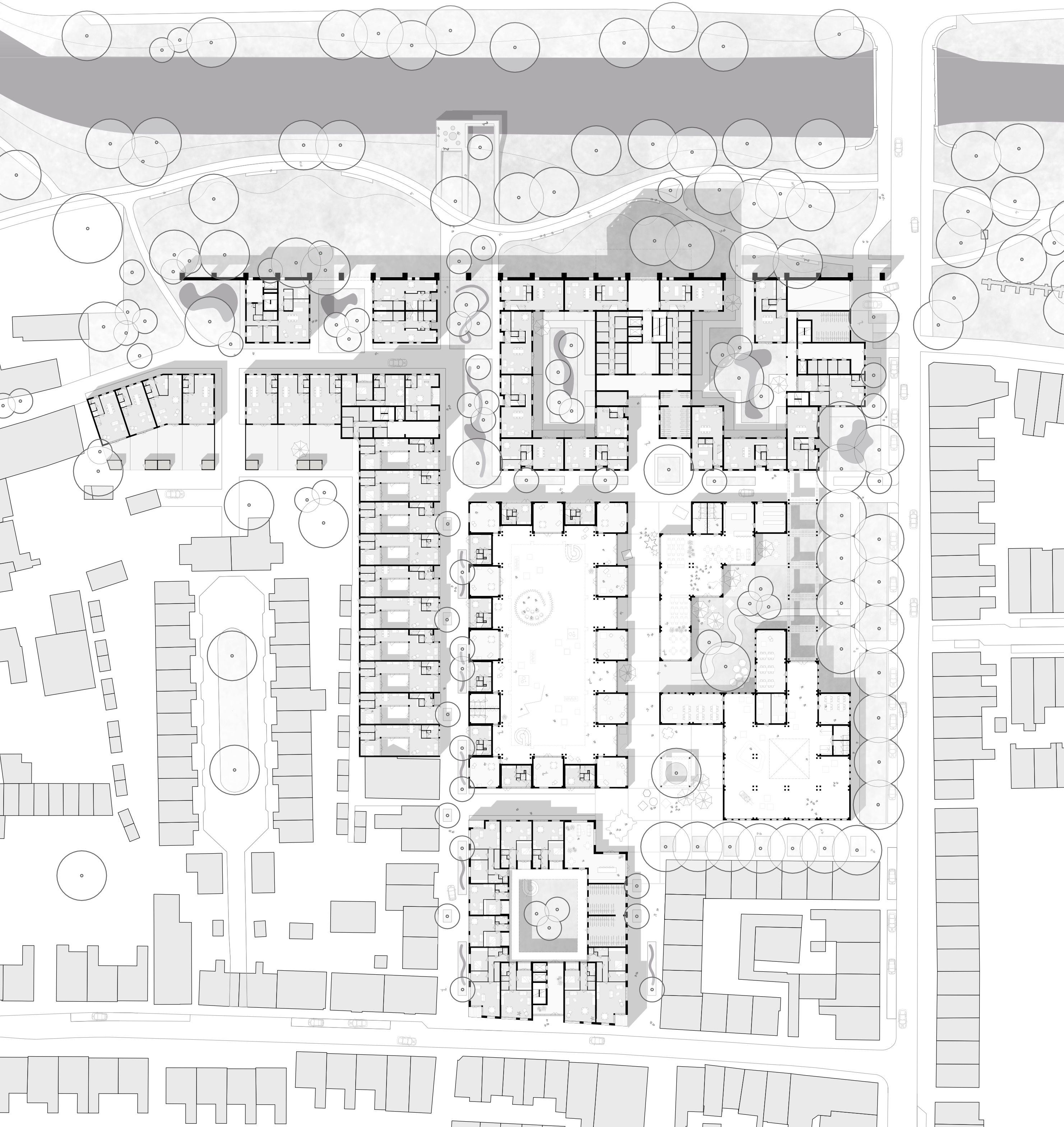
This project proposes turning the entire complex inside out and breaking it up, allowing it to blend
into the morphology and atmosphere of the city centre.
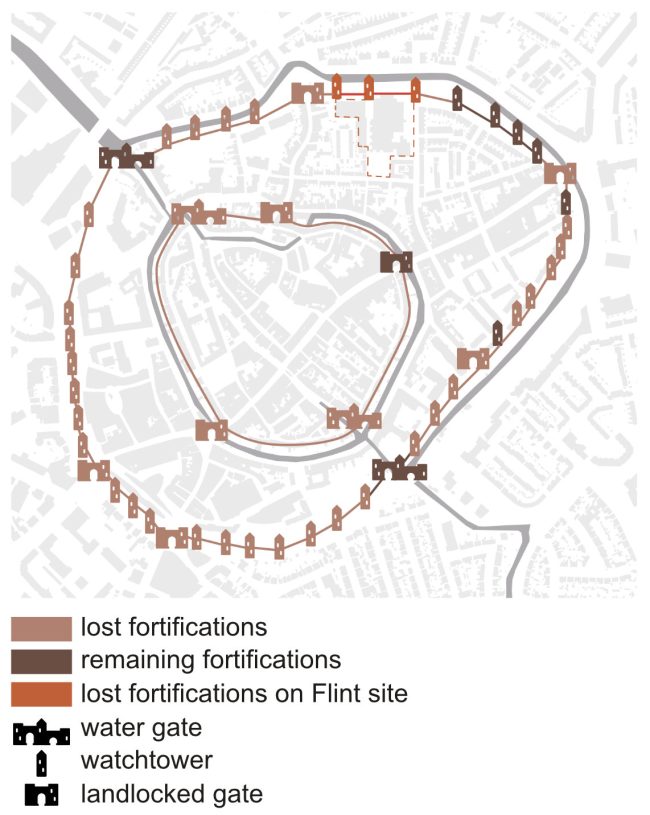
Amersfoort has a well-preserved medieval core. The location of the former city walls is recognisable
in its morphology. Some houses have been built against the city wall over time (Muurhuizen). In other
places, the walls are still standing, or there are green belts.
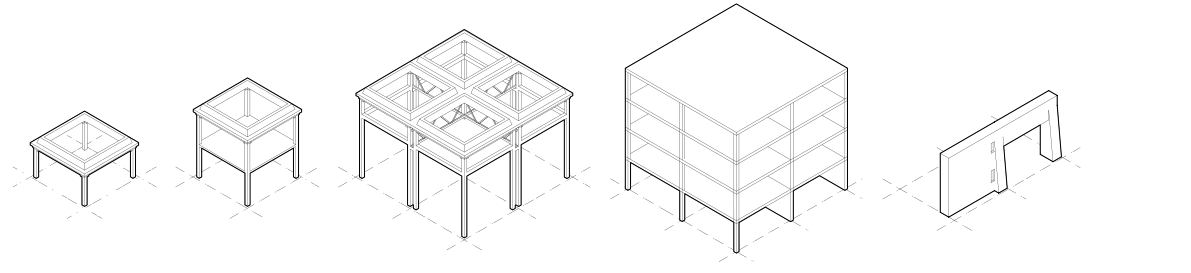
Onno Greiner believed that buildings should serve people, and designed building systems or modules
that fit the human scale. In the case of the Flint, the building is composed of square modules of 6.4
by 6.4 metres. Although the human scale is certainly present in the architecture, the building lacks
a connection to the irregularly shaped medieval fabric, and the large theatre tower of the complex
turns its back on the green belt.
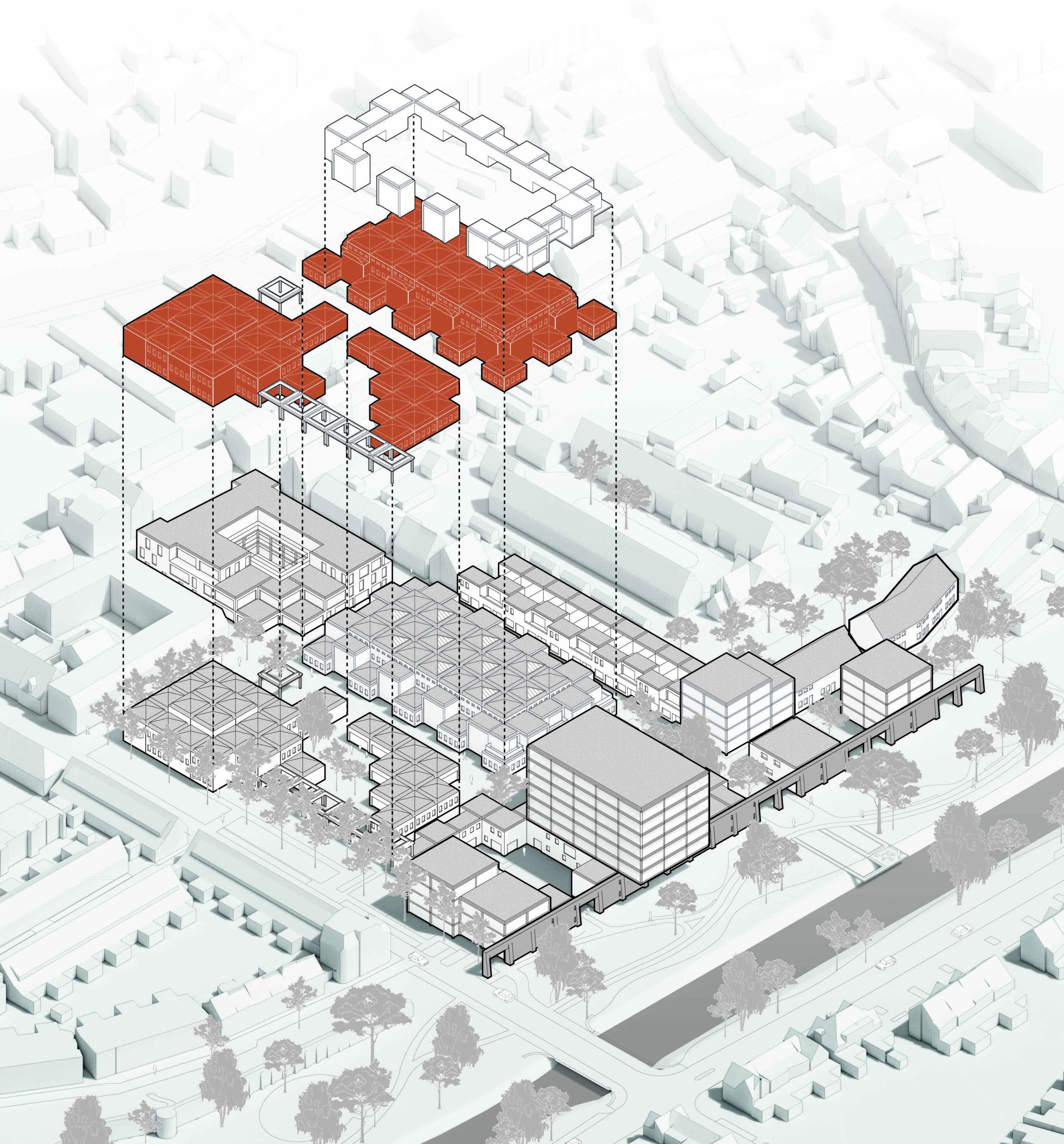
This project explores how Greiner’s modular structure can address the challenges Amersfoort is
expected to face in the coming years, such as adding housing and improving the attractiveness of the
inner city by facilitating an interesting programme with arts, education, leisure and culture, despite
the departure of the theatre. This way, a large part of the Flint complex can be preserved or reused.
Restructuring the complex offers the opportunity to embed it in the city. Choices must be made.
When does Greiner’s modular structure provide a solution, and when should we think outside the
grid? This part of the inner city will also be better connected to the present and the past by creating
a front towards the canal, improving the permeability of the area, and making the location of the old
city wall visible.
The redevelopment builds upon the existing structure of the Flint, adopting an urban perspective
according to the principle ‘Re-value, Re-use, Re-connect’.
Re-value: What is valuable, what is obstructive?
Re-use: What can be reused to solve today’s and future social and spatial challenges?
Re-connect: How can the existing building complex be better integrated into the inner city without
abandoning Onno Greiner’s philosophy?
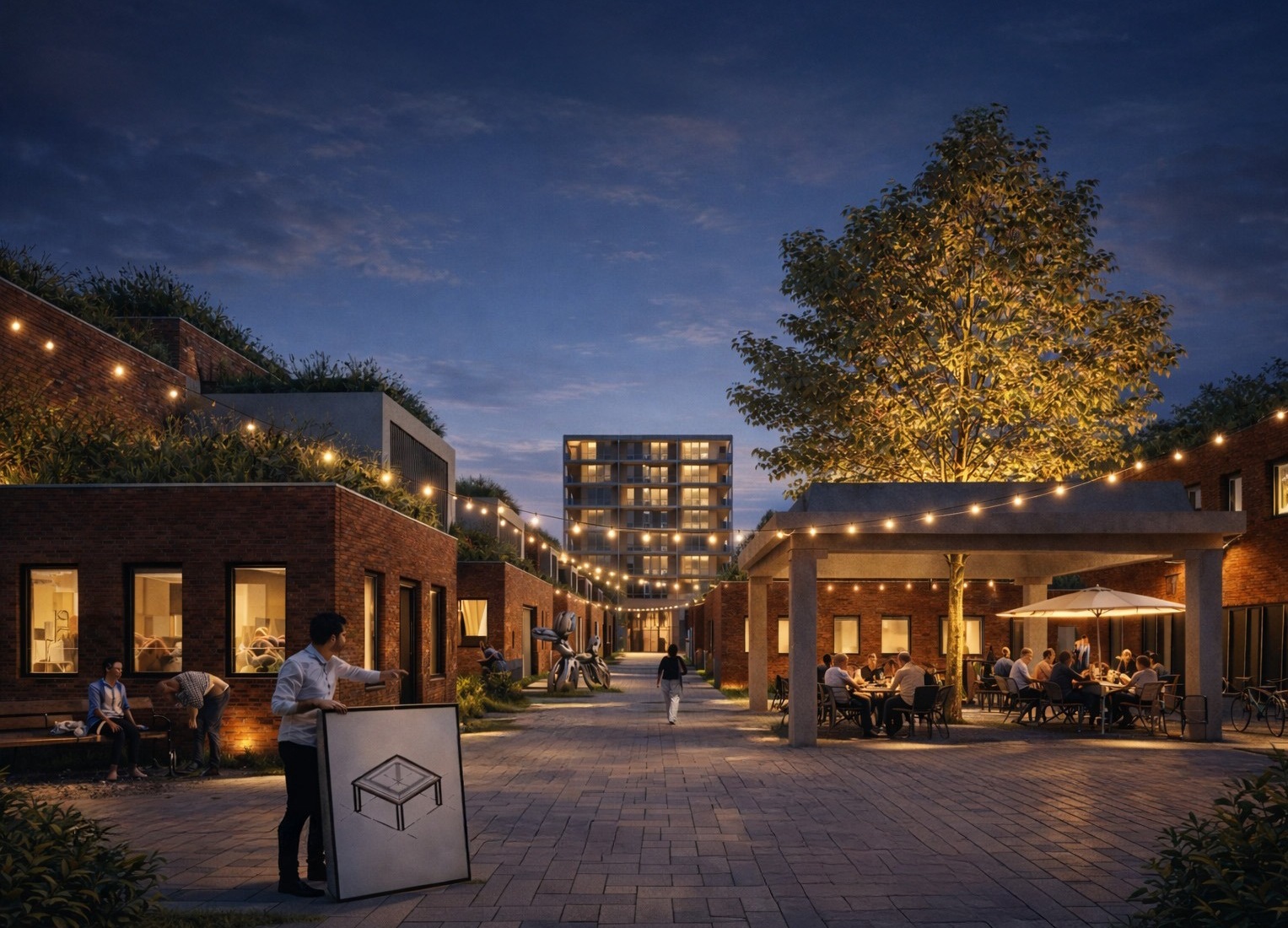
This plan offers living spaces for a diverse range of residents – first-time buyers, families, older
adults, singles, and cohabitants – in a mix of typologies. Social diversity is enhanced by shared
facilities, collective gardens, neighbourhood rooms, studios, maker spaces, office spaces, and
a neighbourhood-oriented restaurant. New building volumes are constructed in timber-frame
construction, and the public space between the buildings is pedestrian-friendly, climate-adaptive,
incorporating greenery and water retention.
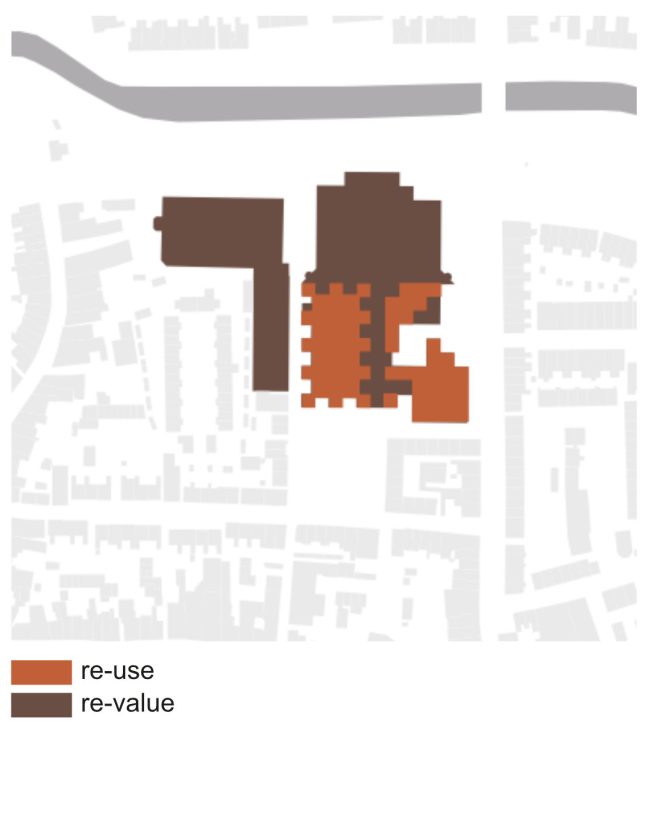
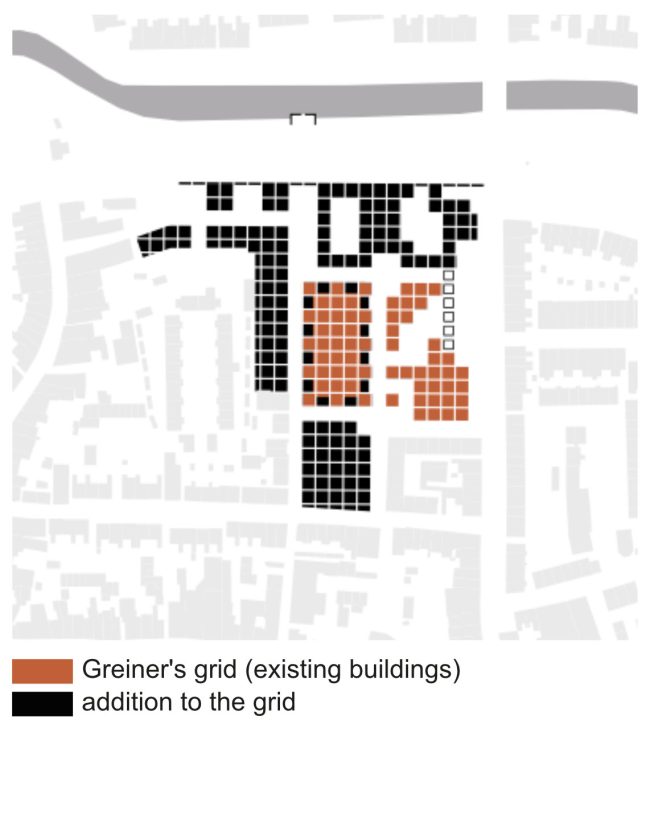
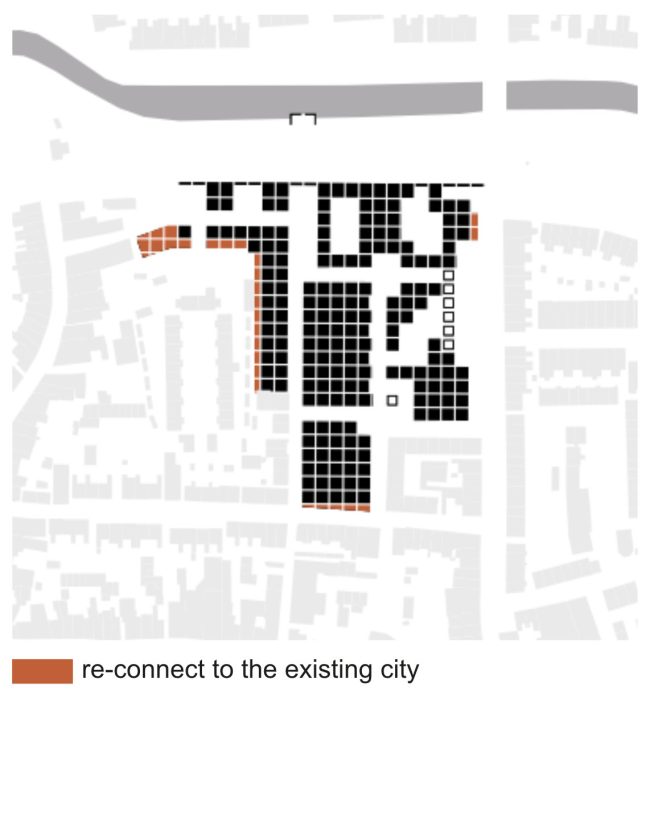
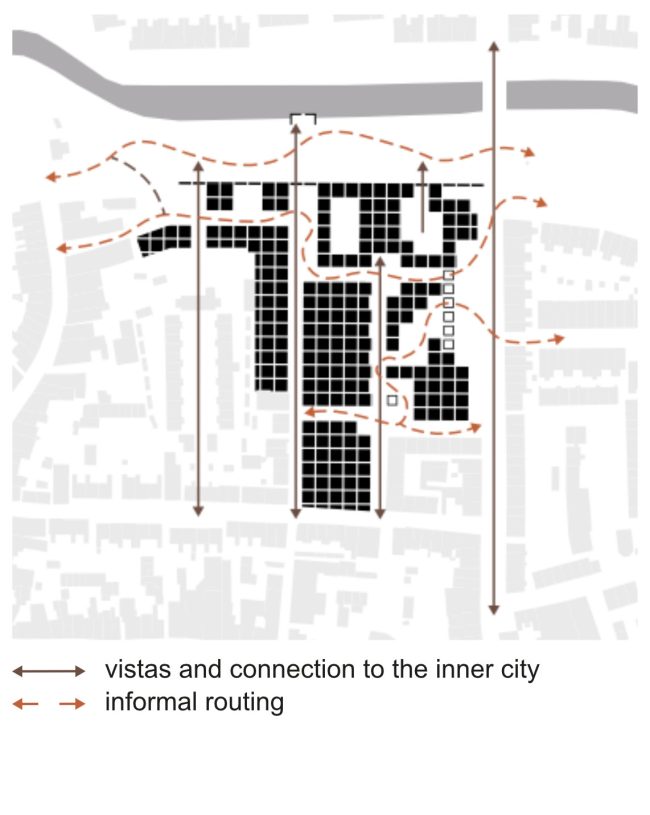
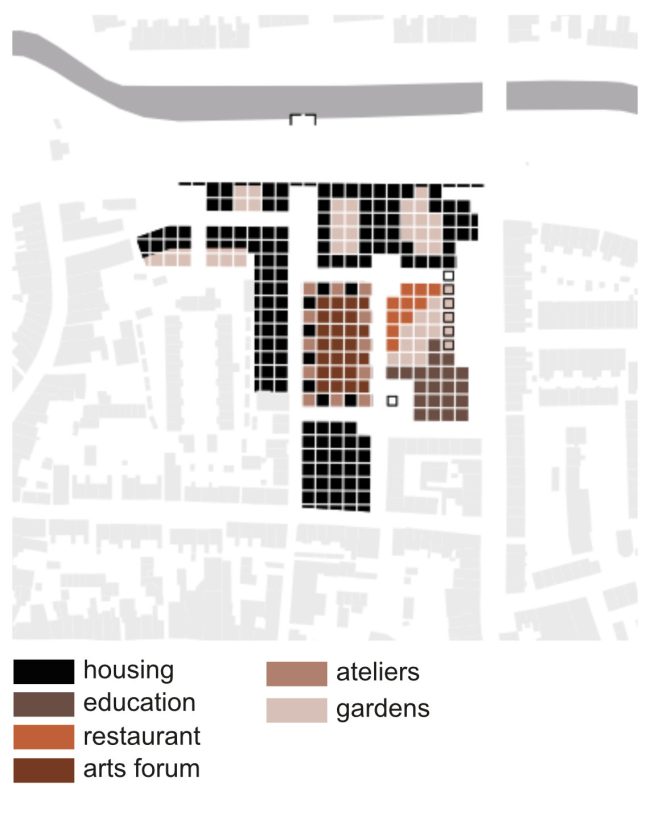
Under ‘Re-value, Re-use, Re-connect’ fall several specific spatial interventions:
Re-value: Large, closed parts of the existing complex that are considered of lesser value to the
building ensemble – such as the later added theatre hall and parking garages – are removed. This
creates space for a new urban fabric, with streets, squares, and passages that connect to the
historical pattern of the city.
Re-use: Greiner’s grid is used as a framework for new infill: housing modules, studio spaces,
stairwells, and shared functions find their place within. In this way, the original design remains
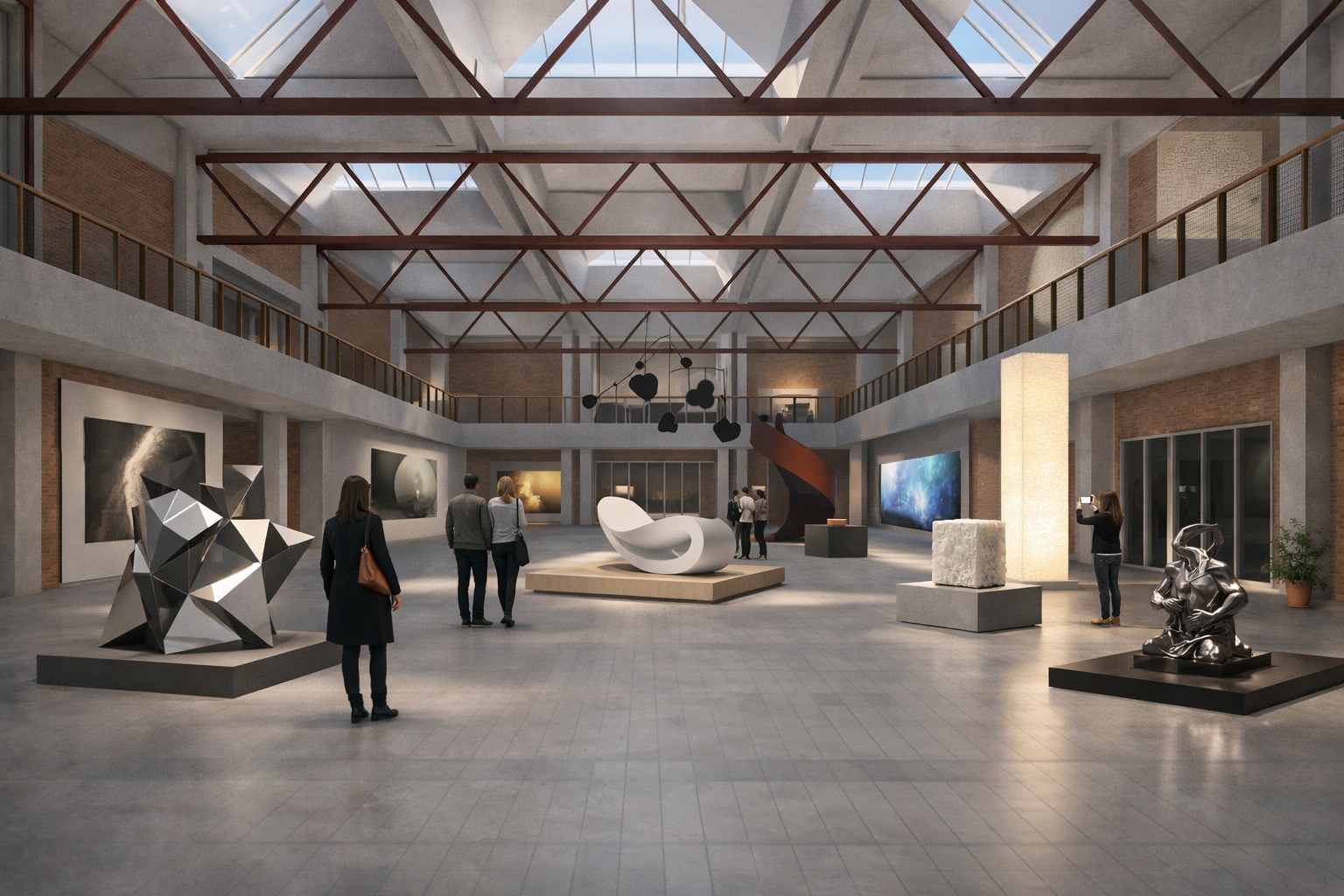
legible and tangible, without becoming dominant. The small theatre hall and the old restaurant are
preserved and repurposed. They will form the heart of a new cluster housing again a restaurant,
exhibition space, studios, and a maker and learning lab with workshops, studios, and shared office
spaces.
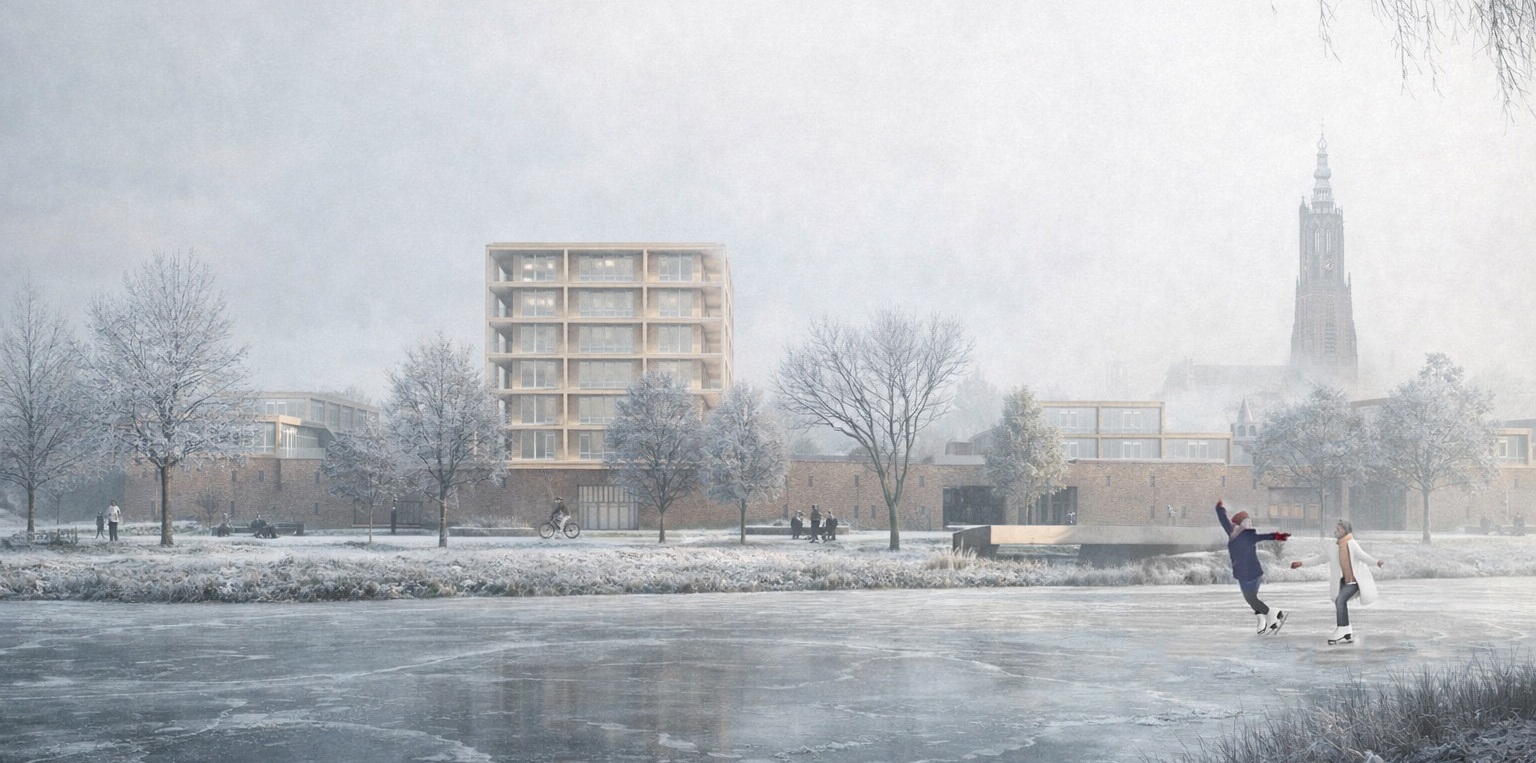
Re-connect: The transition to the canal is strengthened by a new ‘wall volume’ that refers to the old
city wall. Sightlines, routes, and materiality contribute to the anchoring in the place. New housing
volumes are carefully positioned to make the area part of the Amersfoort inner city. Some of
these volumes are against the wall, the ‘Muurhuizen 2.0’. The new building volumes fall within the
‘urban layer’ in terms of height, with a single accent at the location of the former theatre tower. In
places where the grid pinches – for example, in the connection with the existing city – the logic is
consciously deviated from.
This results in a balanced approach between preservation and renewal, and between systematic
design and the unique historical context of Amersfoort. By reimagining Greiner’s grid, the project
embraces continuity while opening space for innovation. It weaves new layers of living, learning,
and making into the inner city, fostering diversity and vibrancy. FlintKwartier becomes not only a
transformation of an iconic structure but a neighbourhood that strengthens Amersfoort’s identity
for generations to come.